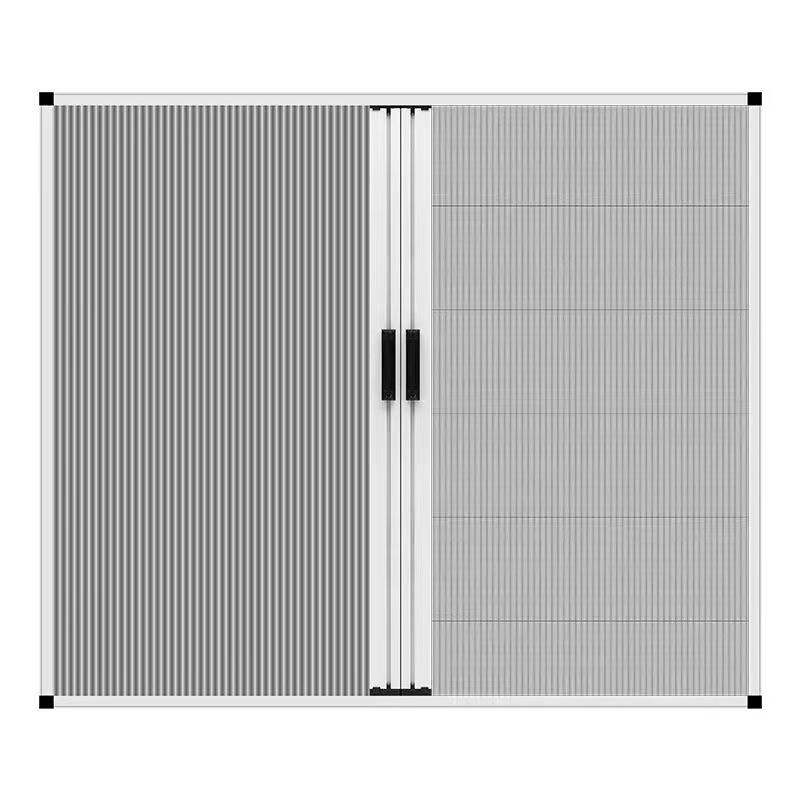
Most custom folding door orders that go wrong don’t go wrong in the factory. They go wrong before the order is placed — in the measurement, the mesh choice, the panel selection or the fixing assumption.
We’ve made thousands of custom doors and shipped them to more than 40 countries. These are the five mistakes we see most often, and how to avoid each one.
Mistake 1: Measuring the Wrong Part of the Doorway This is the single most common cause of a folding door that doesn’t fit.
What people do: They measure the door leaf, or the frame width, or the opening excluding the trim.
What they should do: Measure the full opening between the frame edges — the surface the folding door will actually sit against.
For a folding door, measure the entire opening width and height, including both leaves and the frame between them. For a doorway with a track, measure the track position as well.
How to avoid it: Send a photograph of the doorway with a tape measure in frame. We check every dimension against the photograph before production, and flag anything that looks inconsistent.
Mistake 2: Choosing Mesh for the Wrong Climate A mesh that works in one climate fails in another — not because the product is poor, but because the specification doesn’t match the conditions.
What people do: They order the cheapest mesh, or the one that looks best in a photograph, without considering where the door is going.
What they should do: Match the mesh to the climate:
Coastal and salt-air — stainless steel. Synthetic mesh corrodes and moulds.
Tropical and humid — stainless steel. Synthetic mesh stays damp and supports mould.
Desert and arid — stainless steel. Coarse mesh lets sand through.
Cold and snowy — stainless steel. Synthetic mesh goes brittle and cracks.
Urban and high-pollution — fine stainless steel. Soot stains synthetic mesh permanently.
How to avoid it: Tell us your country and city when you enquire. We match the mesh to the climate before quoting.
Mistake 3: Choosing the Wrong Panel Type Folding doors come with PVC transparent, aluminium or perforated panels. Each one suits a different opening, and choosing the wrong one means living with it for years.
What people do: They choose based on appearance alone, without considering light, privacy, ventilation or pet behaviour.
What they should do:
PVC transparent — preserves the view and daylight. Suits balconies, terraces and garden-facing doors.
Aluminium — offers privacy and screening. Suits street-facing doors and overlooked openings.
Perforated — combines ventilation with partial screening. Suits utility rooms and warm climates.
How to avoid it: Tell us what the door looks onto and how much privacy you need. We’ll recommend the panel type.
Mistake 4: Assuming a Standard Size Will Fit Older housing stock is rarely square or uniform. Victorian terraces, US pre-war apartments, Australian Queenslanders and Singaporean HDB flats all have irregular doorways.
What people do: They buy a standard size and fit it with clips or springs, and accept the edge gap.
What they should do: Measure the actual opening and order to that measurement. An edge gap lets in as much dust and as many insects as an open door.
How to avoid it: Take the minimum width and height measurement, not the average. If the frame is visibly out of square, send photographs and we’ll cut to template.
Mistake 5: Fixing It in a Way That Costs the Deposit For renters, the fixing method matters as much as the mesh.
What people do: They screw the door frame to the door frame, then discover at move-out that the holes cost them the deposit.
What they should do: Specify adhesive fixing. High-strength 3M tape applied to the frame edge holds firmly and lifts away cleanly. No holes, no making good, no deduction.
How to avoid it: Tell us at enquiry whether the property is rented. We’ll specify adhesive fixing as standard and confirm the frame surface is suitable.
A Sixth Mistake Worth Mentioning: Ordering All at Once People often measure one doorway, order one door, fit it, and then realise they need doors on the patio, the balcony and the back door — and have to start the process again.
What to do instead: Measure every opening you’re likely to want screened, in one pass. Send them together. We quote the whole order at once, produce to consistent specifications, and ship in one delivery. It’s cheaper, faster and produces a consistent result across the property.
What We Do to Catch These Mistakes Every order goes through the same checks before production:
Dimension check against photographs — we flag anything inconsistent
Climate-matched specification — mesh and frame recommended for your location
Panel type confirmed — PVC transparent, aluminium or perforated, according to the opening
Fixing method confirmed — adhesive for rentals, screw-fixed available for high-traffic doorways
Removable panel confirmed — every door we make has clip-out panels
Consistent specification across openings — one mesh, one frame finish, one fixing method
If something looks wrong at any of these stages, we raise it before production, not after.
Get a Free Quote Send us your doorway dimensions, photographs and your country. Tell us whether you rent or own, whether you have cats, dogs or both, and how many openings you need. We’ll confirm the specification and reply within 24 hours with a detailed quotation.
WhatsApp: FSMBOR — send your size and country Email: reply within 24 hours
Message us your dimensions for a free quote.
Five mistakes that ruin a custom folding door order — measuring the wrong surface, choosing mesh for the wrong climate, choosing the wrong panel type, assuming standard sizes fit, and fixing in a way that costs the rental deposit. 304 stainless steel mesh, aluminium alloy frames, PVC transparent, aluminium or perforated panels, adhesive or screw fixing, removable and washable, manufactured in Foshan and shipped worldwide.