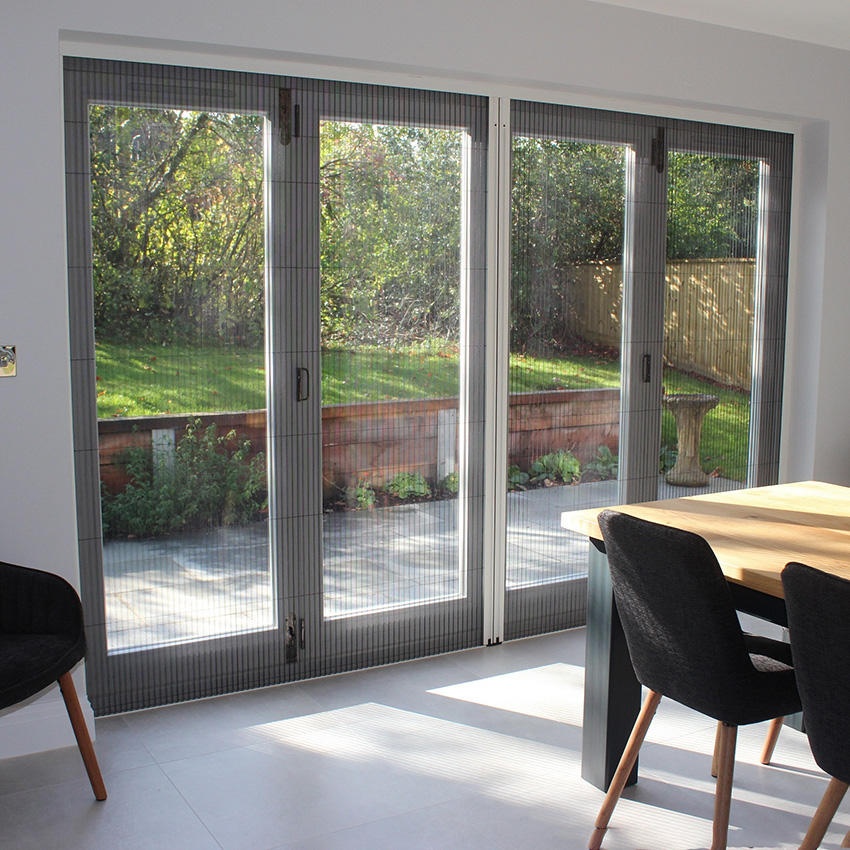
A folding door in a restaurant, café, hotel or pet-friendly venue has a different job from one in a house.
The dining room needs to be open — to the street, the patio, the garden — because that’s the appeal of the space. But an open dining room means flies, wasps and dust in the food service area. And in most jurisdictions, food safety regulations take a dim view of that.
Add pets — pet-friendly patios, dog-friendly cafés, guests with service animals — and the specification tightens. The door opens and closes constantly. A dog on the patio leans on the screen. A customer props the door open with a chair because their hands are full. And the screen that was meant to keep the flies out has been propped open all evening.
Why Standard Doors Fail in Hospitality Staff carry things. Trays, ingredients, bins, delivery boxes. Nobody has a free hand to push a door open. A hinged screen door gets propped, and the insects come in.
Guests bring dogs. Pet-friendly venues attract dogs. A dog leans on the screen, pushes through the door and tests the mesh.
Doors are in near-constant use. Front doors, back doors, patio doors, service doors. A standard screen door doesn’t survive that frequency.
Grease and cooking fumes. In venues where the kitchen is near the dining room, cooking fumes settle on the mesh. The door has to be washable, not just wipeable.
Hygiene inspections. Food service areas have to be clean and pest-controlled. A door that can’t be removed for cleaning is a hygiene problem.
Leased premises. Many restaurants and cafés lease their space. Screw-fixed doors leave holes and require making good at the end of the lease.
Brand consistency. A chain wants the same frame finish and the same system in every branch. One specification, applied consistently.
Older buildings. Many venues are in older buildings with non-standard door frames. Off-the-shelf doors leave gaps.
What a Commercial Folding Door Needs to Do Open without a free hand — so staff carrying trays and stock aren’t slowed down
Not obstruct the opening — so deliveries and equipment can pass
Resist dogs and heavy use — so the mesh survives the season
Be washable and disinfectable — so hygiene inspections are straightforward
Install without drilling — so leased premises aren’t damaged
Look finished — so the door doesn’t spoil the dining room
Specification Mesh: 304 stainless steel. Densely woven, impact-resistant, non-deforming. It resists clawing, pushing and daily wear, wipes clean, and can be disinfected. It’s rust- and corrosion-resistant, which matters in coastal venues and in humid climates. For restaurants, hotels and pet-friendly venues, this is the appropriate specification.
Frame: aluminium alloy. Rigid, warp-resistant, rust-free. Available in classic white, modern grey or a colour-matched finish for chain consistency.
Panels: PVC transparent, aluminium or perforated. PVC transparent preserves the view from the dining room. Aluminium offers privacy and screening. Perforated panels combine ventilation with partial screening.
Design: double-panel, opening from the centre. Staff, guests, dogs and delivery trolleys pass through without stopping. Panels fold back to 5–8cm at the sides when not required, so the opening stays clear and there’s no reason to prop the door open.
Fixing: 3M adhesive or screw-fixed. Adhesive for leased premises and finished door frames — no drilling, fully reversible. Screw fixing for the highest-traffic entrances and wind-exposed elevations.
Cleaning: clip-out panels. Press the catches, lift the panel out, rinse or disinfect, let it dry, clip it back. Two minutes, no tools.
Where It Goes Restaurant back doors, kitchen doors, café front doors, bar side doors, hotel balcony doors, terrace doors, courtyard doors, takeaway collection doors and warehouse doors.
For sliding and multi-leaf openings, panel configuration and fixing points are agreed before production so the screen doesn’t interfere with the door operation.
Regional Notes Northeast and Midwest US, northern Europe — freeze-thaw cycles, seasonal patios, road salt. Specify stainless steel mesh; adhesive fixing for leased premises.
South and Southeast US, Southeast Asia — humidity, mould, mosquitoes and flies. Specify stainless steel mesh, which is non-absorbent and doesn’t support mould growth.
Southwest US, Middle East — fine sand, dust storms and high heat. Specify stainless steel mesh; rinse after every dust storm.
West Coast US, Mediterranean, wildfire regions — fine smoke particulate. Specify stainless steel mesh, and rinse after every smoke event. Outdoor dining may be closed during smoke events.
Coastal regions worldwide — salt air and corrosion. Specify stainless steel mesh and aluminium frames; rinse every two months.
How It Works Measure the openings. Full opening width and height for each door. For folding doors, measure each panel if specified.
Send dimensions and photos. We confirm the fit before production, free of charge.
Choose panels and fixing. PVC transparent, aluminium or perforated panels. Adhesive or screw-fixed.
Get a quote. Detailed quotation within 24 hours, itemised by opening. Samples available.
Production and shipping. Bulk production 15–25 days, shipped by sea, air or express.
Install. Adhesive fixing, no drilling required.
Get a Free Quote Send us your opening dimensions, photographs, your country and the venue type. Tell us whether the venue is pet-friendly, whether the premises are leased, and whether you need a colour-matched finish for multiple branches. We’ll recommend the right specification and reply within 24 hours.
WhatsApp: FSMBOR — send your size and country Email: reply within 24 hours
Message us your venue details for a free quote.
Commercial folding doors for restaurants, cafés, hotels and pet-friendly venues — double-panel design that opens from the centre, folds back to 5–8cm, 304 stainless steel mesh, aluminium alloy frames, PVC transparent, aluminium or perforated panels, adhesive or screw fixing, removable and washable, custom-made in Foshan and shipped worldwide.