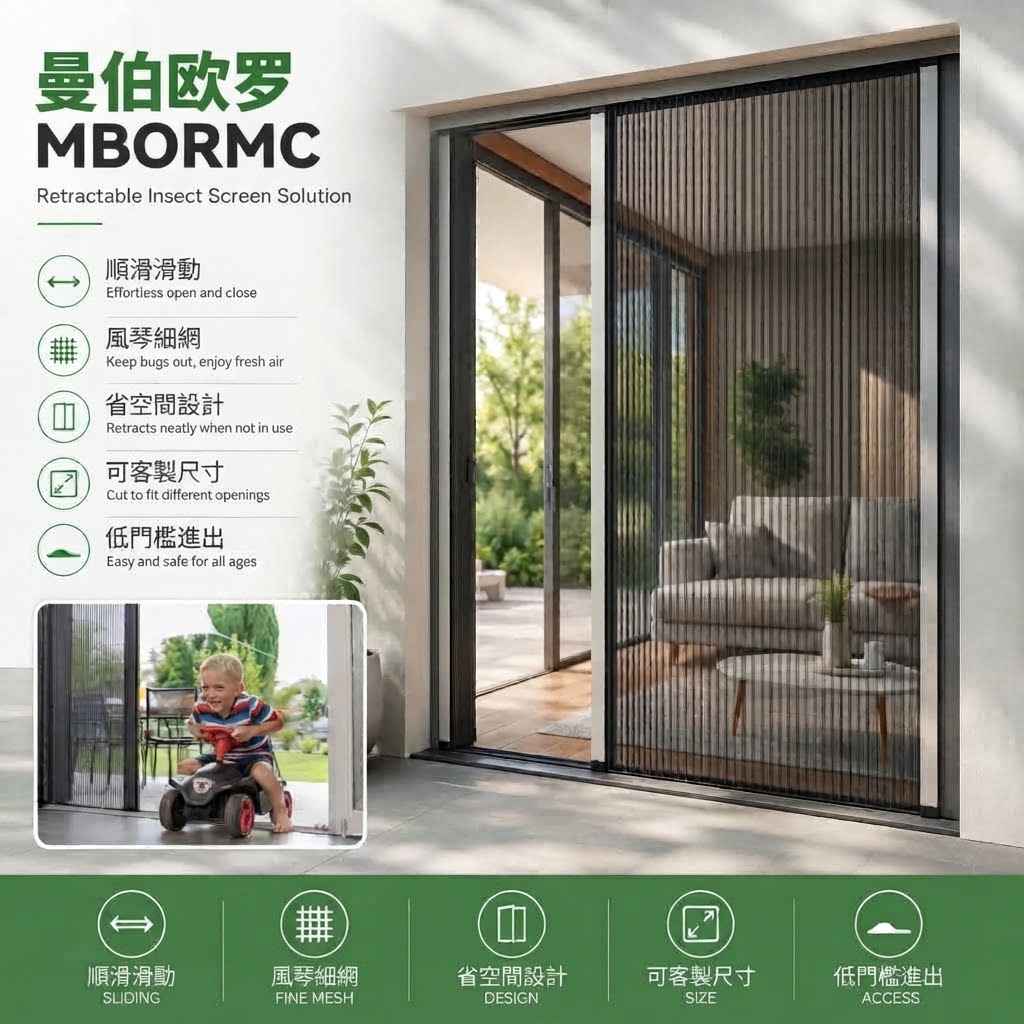
Three types of screen door dominate the market: hinged, magnetic and folding. They look similar in photographs and cost different amounts, but they behave very differently in daily use — especially in a house with pets.
This page sets out how each one works, where each one fails, and which one suits which household.
Hinged Screen Door How it works: A single panel on hinges, pushed open by hand, shoulder or hip, and closed by a spring or a self-closing mechanism.
Strengths: Cheap, widely available, familiar to use.
Where it fails:
It needs a free hand. With shopping, a cooler, a laundry basket or a dog on a lead, there’s no free hand. The door gets propped open.
It obstructs the opening. It swings into the doorway, so moving furniture, garden equipment or a buggy means pushing it out of the way.
It doesn’t work well for pets. A dog has to push it open with its nose and squeeze through before it swings shut. Some dogs learn; many don’t.
It can’t be cleaned easily. A spline-and-track door can’t be removed for washing. It clogs and stays clogged.
It’s usually screw-fixed. For renters, that’s a deposit deduction.
Best for: Households without pets, in mild climates, where the door is used lightly and a free hand is usually available.
Magnetic Screen Door How it works: A mesh curtain held closed by magnets along the centre seam. It opens when pushed and closes automatically as the magnets re-engage.
Strengths: Opens easily under a hand or a nose. Cheap. No tools to install.
Where it fails:
The magnets weaken over time. Once the seam doesn’t close properly, insects enter through the gap.
The mesh is usually lightweight. It tears under a dog’s paw or a cat’s claw, and it doesn’t resist wind.
It doesn’t seal at the edges. The mesh hangs loose against the frame, so there’s a gap around the perimeter.
It looks temporary. It’s fine for a rental or a short season, but it isn’t a finished installation.
It doesn’t handle impact. A dog charging a magnetic door will push straight through it.
Best for: Rental properties, temporary installations, mild climates, and households with cats that don’t push hard.
Folding Screen Door How it works: Two panels that meet in the middle and open from the centre, folding back against the frame when not in use.
Strengths:
Opens without a free hand. A push from either side opens it.
Doesn’t obstruct the opening. Panels fold back to 5–8cm at the sides, so the doorway stays clear.
Works for pets. A dog runs through without breaking stride.
Takes impact. 304 stainless steel mesh resists clawing, leaning and charging without deforming.
Comes out for cleaning. Clip-out panels rinse clean in two minutes.
Installs without drilling. 3M adhesive fixing, fully reversible, or screw fixing for high-traffic doorways.
Looks like a finished installation. Rigid aluminium frame in white, grey or a colour-matched finish.
Where it falls short: Higher unit cost than a hinged or magnetic door, and it needs the opening to be measured accurately. It’s a custom product, not an off-the-shelf one.
Best for: Pet households, high-traffic doorways, rental properties that need reversibility, and homeowners who want a finished installation rather than a temporary fix.
Side-by-Side Comparison Feature Hinged Magnetic Folding Opens without a free hand No Yes Yes Obstructs the opening Yes Partly No — folds to 5–8cm Works for charging dogs No No Yes Resists clawing No No Yes Seals at the edges Yes No Yes Removable for cleaning No Partly Yes Adhesive fixing option Rarely Yes Yes Looks like a finished installation Yes No Yes Unit cost Low Low Higher The Real Decision The question isn’t which door is cheapest. It’s which door will actually be used.
A hinged screen door is cheap, but if it gets propped open every evening, it isn’t doing its job. A magnetic door is easy to walk through, but if the magnets fail in the second season, it isn’t doing its job either. A folding door costs more, but it opens without a free hand, doesn’t obstruct the opening, survives pets and comes out for cleaning — so it stays closed and keeps working.
For a household with a dog that charges the door, a cat that claws at the mesh, or a climate that destroys cheap materials, the folding door is the only one of the three that holds up.
How It Works With Window Screens A folding screen door handles the doorway. A pet-proof dust screen handles the windows. Both use the same materials — stainless steel or ultra-fine mesh, aluminium frames, adhesive fixing, clip-out panels — so the specification stays consistent across the property.
Get a Free Quote Send us your doorway dimensions, photographs and your country. Tell us what kind of dog or cat you have and how heavily the door is used. We’ll recommend the right door type and specification and reply within 24 hours.
WhatsApp: FSMBOR — send your size and country Email: reply within 24 hours
Message us your doorway size for a free quote.
Folding screen doors versus hinged and magnetic screen doors — how each one works, where each one fails, and which suits pet households and high-traffic doorways. 304 stainless steel mesh, rigid aluminium alloy frame, adhesive or screw fixing, removable and washable panels, custom-made in Foshan and shipped worldwide.