Most pet households solve one opening at a time. A screen door on the back door because the dog charges it. A window screen in the bedroom because the cat sits on the sill. Then the next opening, and the next, each one bought separately, each one a slightly different specification.
The result is a patchwork. Different meshes, different frame finishes, different fixing methods, bought at different times and never quite matching. And there’s usually one opening that gets missed — the one nobody thought about until the insects arrived.
A better approach is to specify the whole house at once: a folding screen door for the doorways, pet-proof dust screens for the windows, both built to the same materials and the same fixing method.
Where Pets Actually Enter and Exit Pets use a house in a predictable way.
Doorways. Back doors, patio doors, garden doors and balcony doors are the main routes in and out. They open dozens of times a day, and they’re where a dog charges and a cat slips through.
Windows. Windows are where pets sit, watch and claw. They’re not usually a route in and out, but they’re where the mesh takes the most sustained contact — a cat leaning on the sill for hours, a dog pushing against the frame to see the street.
The openings between. Sliding doors, bi-fold doors, French doors and utility room doors are the in-between openings that get used heavily but are often overlooked when screens are specified.
A complete specification covers all three.
Why Doorways and Windows Need Different Products A doorway screen has to survive impact. A window screen has to survive sustained contact and filter dust.
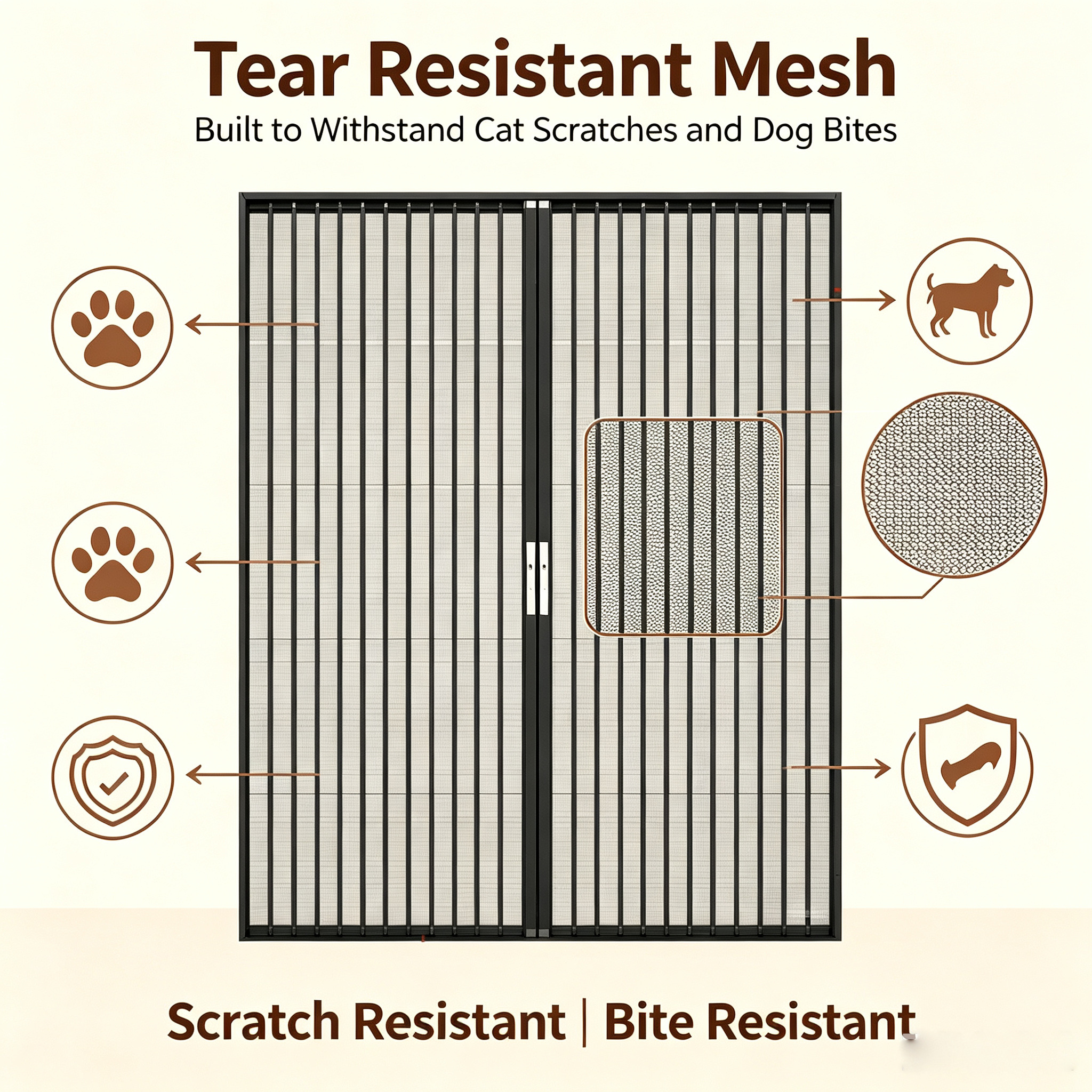
Doorways: the priority is impact resistance and ease of access. A folding screen door with 304 stainless steel mesh, opening from the centre and folding back to 5–8cm, is the appropriate specification. It takes a dog charging it, opens without a free hand, and doesn’t get propped open.
Windows: the priority is claw resistance, dust and pollen filtration, and airflow. A pet-proof dust screen with ultra-fine mesh or stainless steel mesh, custom-cut to the opening and fixed with 3M adhesive, is the appropriate specification. It resists claw snagging, captures fine particulate, and clips out for washing.
Using a door product on a window, or a window product on a door, is where most specifications go wrong.
What Stays Consistent Across the Property Even though the products differ, the specification should match.
Mesh material. Stainless steel on both, or ultra-fine on both, depending on the climate. A house with stainless steel doors and synthetic window screens looks mismatched and fails at different rates.
Frame finish. The same colour across every opening, so the property reads as a whole.
Fixing method. Adhesive fixing throughout, or screw fixing only on the highest-traffic doorways. Consistency simplifies maintenance and replacement.
Cleaning routine. Clip-out panels on every opening means one routine, one schedule, one set of habits.
The Case for Specifying Together One measurement pass. Measure every opening in the house once, send them together, and we quote and produce the whole order as a set.
Consistent specification. One mesh, one frame finish, one fixing method across every opening. The property reads as a whole rather than a series of separate additions.
One delivery. Screens and doors produced together and shipped in one consignment.
One installation session. Fit every opening in one pass rather than coming back to it week after week.
Better value. Bundle orders are quoted together, and multi-item orders are more efficient to produce and ship.
Fewer gaps in protection. A pet-proof doorway with an unscreened window is still a house with an insect and dust problem. Covering both closes the whole envelope.
A Simple Specification Template For a typical pet household, the specification looks like this:
Doorways — folding screen doors in 304 stainless steel mesh, aluminium alloy frame, opening from the centre, folding back to 5–8cm. Adhesive fixing on standard doors, screw fixing on high-traffic back doors and patio doors.
Windows — pet-proof dust screens in ultra-fine mesh or stainless steel mesh, custom-cut to each opening, aluminium frame in the same finish as the doors, 3M adhesive fixing, clip-out panels.
Climate adjustments — stainless steel throughout for coastal, humid, cold or high-pollution climates. Ultra-fine mesh for pollen-heavy regions and bedrooms. Both specified for the local conditions.
Regional Notes Coastal and salt-air regions — stainless steel throughout, aluminium frames, adhesive fixing. Rinse every two months.
Tropical and humid regions — stainless steel throughout, non-absorbent, mould-resistant. Rinse monthly.
Desert and arid regions — ultra-fine stainless steel on windows, stainless steel on doors. Rinse after every dust storm.
Cold and snowy regions — stainless steel throughout, non-brittle, non-contracting frames. Clean twice a year.
Urban and high-pollution regions — fine stainless steel throughout, smooth surface that wipes clean. Clean monthly.
Rental properties — adhesive fixing throughout, fully reversible, deposit-safe.
Get a Free Quote Send us the dimensions and photographs of every opening you want screened — doors and windows — along with your country and your pets. We’ll confirm the specification for each and reply within 24 hours with a detailed quotation itemised by opening.
WhatsApp: FSMBOR — send your size and country Email: reply within 24 hours
Message us your opening details for a free quote.
Pairing folding screen doors with pet-proof window screens — covering doorways, windows and the openings between, with consistent mesh, frame finish and fixing method across the property. 304 stainless steel mesh, ultra-fine dust mesh, aluminium frames, adhesive fixing without drilling, removable and washable panels, custom-made in Foshan and shipped worldwide.