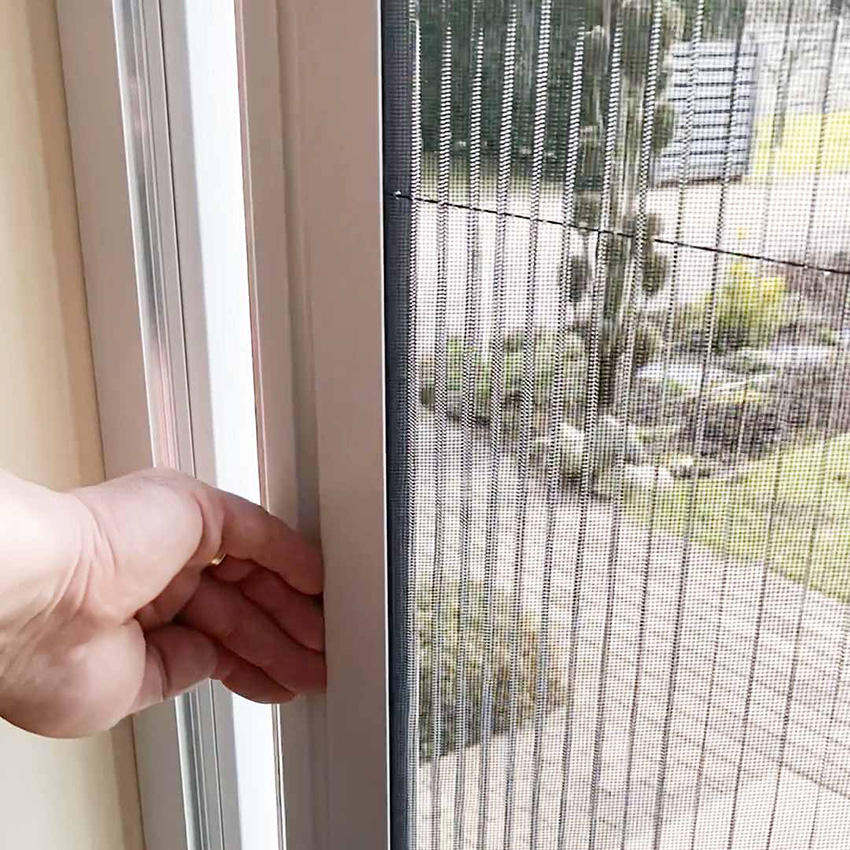
A folding screen door is a screen door that splits down the middle and opens from the centre, rather than swinging on a hinge. Both panels fold back against the frame when not in use, so the opening stays clear.
It was designed for a specific problem: standard screen doors are inconvenient enough that people stop using them. They need a free hand to push open. They swing shut on your heels. They get in the way when you’re carrying something. So they get propped open with a brick or a chair — and the insects walk in.
A folding screen door removes the reason to prop it open.
How It Works Double-panel design. The door is made of two panels that meet in the middle. Both open outward, so a person or a pet can pass through from either side without stopping.
Folds back to 5–8cm. When the door is open and the screen isn’t needed, both panels fold back against the frame. Narrower than a smartphone. No obstruction, no visual clutter.
Rigid aluminium alloy frame. The frame is rigid, so it doesn’t flex when a pet leans on it or when the wind catches it. Available in classic white or modern grey, or colour-matched for larger orders.
Panel options. PVC transparent panels, aluminium panels or perforated round-hole panels, depending on how much visibility and airflow you want.
Dual fixing. 3M adhesive for rentals and finished surfaces — no drilling, fully reversible. Screw fixing for high-traffic doorways and exposed locations.
Why Pet Owners Choose It Over a Standard Screen Door Dogs don’t have to stop. A dog using a hinged screen door has to push it open with its nose and squeeze through before it swings shut. Some dogs learn. Many don’t. A folding door opens from the centre, so a dog runs through without breaking stride.
Full hands aren’t a problem. A standard screen door needs a free hand. With shopping, a cooler, a laundry basket or a dog on a lead, that hand doesn’t exist. A folding door opens with a push from either side.
It doesn’t get propped open. The most common reason a screen door fails is that it gets propped open and left that way. A door that folds back to 5–8cm doesn’t obstruct anything, so there’s no reason to prop it.
It survives impact. The mesh is 304 stainless steel — densely woven, impact-resistant, non-deforming. A dog can charge it, lean on it and push through it without the weave stretching or tearing. Standard fibreglass and nylon mesh stretches under the first charge and tears at the frame edge.
It comes out for cleaning. Press the catches, lift the panel out, rinse it, let it dry, clip it back. A standard spline-and-track door can’t be removed, so it clogs with dust, pollen and pet hair and stays clogged.
It installs without drilling. Adhesive fixing leaves no holes in the door frame, threshold or siding. For renters, that protects the deposit. For homeowners, it’s a reversible upgrade.
How It Compares to Other Screen Door Types Hinged screen door. The traditional option. Requires a free hand, swings into the opening, and gets propped open. Cheaper to buy, but more likely to be left open.
Magnetic screen door. Opens easily under a nose or a hand, but the magnetic closure can fail over time, and the mesh is usually lightweight. Suitable for mild climates and light use, not for dogs that charge.
Retractable screen door. Pulls across when needed and retracts into a housing. Good for doors that need to be clear at times, but the housing and track need regular cleaning, and the mechanism can jam in dusty environments.
Folding screen door. Opens from the centre, folds back to 5–8cm, takes impact, and comes out for cleaning. The most practical option for pet households and high-traffic doorways.
Where It Goes Back doors, patio doors, garden doors, porch doors, balcony doors, French doors, sliding door openings, garage doors and utility room doors.
For sliding and multi-leaf openings, panel configuration and fixing points are agreed before production so the screen doesn’t interfere with the door operation.
Regional Notes Northeast and Midwest US, northern Europe, Canada — freeze-thaw cycles and road salt. Specify stainless steel mesh and aluminium frames; synthetic mesh goes brittle in winter.
South and Southeast US, Southeast Asia, tropical regions — humidity, mould and heavy insect pressure. Specify stainless steel mesh, which is non-absorbent and doesn’t support mould growth.
Southwest US, Middle East, inland Australia — fine sand, dust storms and high heat. Specify stainless steel mesh; rinse after every dust storm.
West Coast US, Mediterranean, wildfire regions — fine smoke particulate. Specify stainless steel mesh, and rinse after every smoke event.
Coastal regions worldwide — salt air and corrosion. Specify stainless steel mesh and aluminium frames.
How It Works With Our Window Screens A folding screen door handles the doorway. A pet-proof dust screen handles the windows. Together they cover the openings where pets, dust and insects actually enter.
Window screens use the same materials — stainless steel or ultra-fine mesh, aluminium frames, adhesive fixing, clip-out panels — so the specification is consistent across the property.
Get a Free Quote Send us your doorway dimensions, photographs and your country. Tell us what kind of dog or cat you have and how heavily the door is used. We’ll recommend the right panel, frame finish and fixing and reply within 24 hours.
WhatsApp: FSMBOR — send your size and country Email: reply within 24 hours
Message us your doorway size for a free quote.
A folding screen door splits down the middle and opens from the centre, folds back to 5–8cm, and is built for pet households and high-traffic doorways. 304 stainless steel mesh, rigid aluminium alloy frame, PVC / aluminium / perforated panels, adhesive or screw fixing, removable and washable panels, custom-made in Foshan and shipped worldwide.