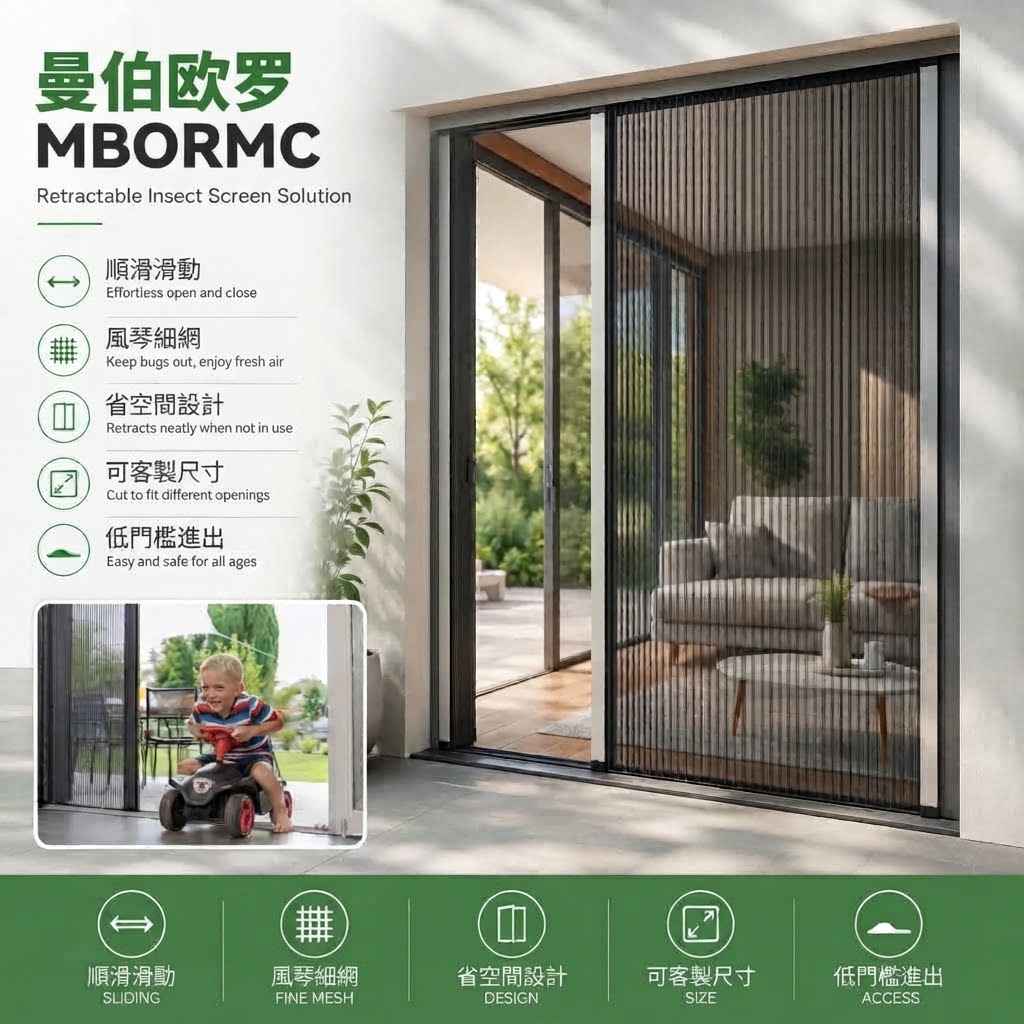
The Renter’s Problem: Need a Screen, Cannot Drill For renters, the need for a screen door is real — pets, insects, pollen, heat — but the solution is constrained by the lease. Many rental agreements explicitly prohibit drilling into doors, window frames, or walls. A tenant who installs a traditional screen door risks losing part of the security deposit, or being asked to remove the screen and restore the frame at their own cost.
The practical answer is a screen door that mounts without drilling and can be removed cleanly. This is not a niche need: in cities like New York, London, Berlin, Tokyo, and Sydney, a large share of the population rents, and pet ownership among renters has been rising for years.
How Adhesive Mounting Works Adhesive-mounted screens use a high-strength tape — typically 3M adhesive — to attach the frame to the door or window frame. No screws, no drill, no holes. The tape is designed to hold the weight of the screen and to release cleanly when the screen is removed.
The FD01 supports adhesive mounting, and the H01 magnetic window screen uses a similar approach. For renters, this means a screen can be installed in minutes and removed at the end of the lease without leaving a mark on the frame.
What “Deposit-Safe” Actually Means “Deposit-safe” is not a guarantee — it depends on how the screen is installed and removed. The practical rules are:
Clean the frame before mounting. Dust and grease weaken the adhesive and leave residue.
Apply the tape at room temperature. Adhesive cures best in warm conditions; installing in cold weather reduces holding strength.
Remove the screen slowly. Pull the tape at a low angle, not straight out, to avoid lifting paint or leaving residue.
Use adhesive remover if needed. A small amount of isopropyl alcohol or commercial adhesive remover cleans any residue without damaging most painted surfaces.
Follow these steps and the frame is left as it was found. Skip them and the adhesive may leave a residue that the landlord notices at inspection.
Screen Types for Renters Folding screen door (FD01): best for patio and balcony doors, and for renters with pets. Adhesive mounting is available, and the folding design means the screen gathers to one side rather than swinging open.
Magnetic window screen (H01): best for sash and casement windows. The magnetic frame attaches without drilling and can be removed for cleaning.
Dust filter screen (FD04): also available with adhesive mounting, suitable for renters in high-pollution or high-pollen cities.
Thermal screen (H05): for renters in hot climates, adhesive mounting is available for most window types.
Limitations Renters Should Know Adhesive mounting is not suitable for every situation. It works best on smooth, clean, painted or metal frames. Rough or textured frames may not hold the tape reliably. Very heavy screens — large patio doors with steel mesh — may need screw-fixed mounting for safety, which is not an option for most renters.
For very wide patio doors or heavy pet-proof screens, the practical option is to ask the landlord for written permission to use screw-fixed mounting, and to offer to restore the frame at the end of the lease. Many landlords agree when the screen is removable and the restoration is straightforward.
Moving Out: Removing the Screen At the end of the lease, the screen should be removed cleanly. The steps are:
Remove the screen from the frame, not the tape from the frame first.
Pull the tape slowly at a low angle.
Clean any residue with isopropyl alcohol.
Check the frame for paint damage; touch up if needed.
A screen that is removed carefully leaves no trace. A screen that is pulled off quickly may leave tape residue or lift paint — the difference is in the removal, not the installation.
What to Ask Before Ordering For renters, ask three questions: Is adhesive mounting available for this screen? What frame surfaces does the adhesive work on? What is the removal process? The FD01, H01, H05, and FD04 all offer adhesive mounting options, and custom sizing means the screen fits the specific door or window in the rental unit.
A screen door does not have to be a landlord problem. With the right mounting method and a careful removal, renters can have the same protection as homeowners — without risking the deposit.