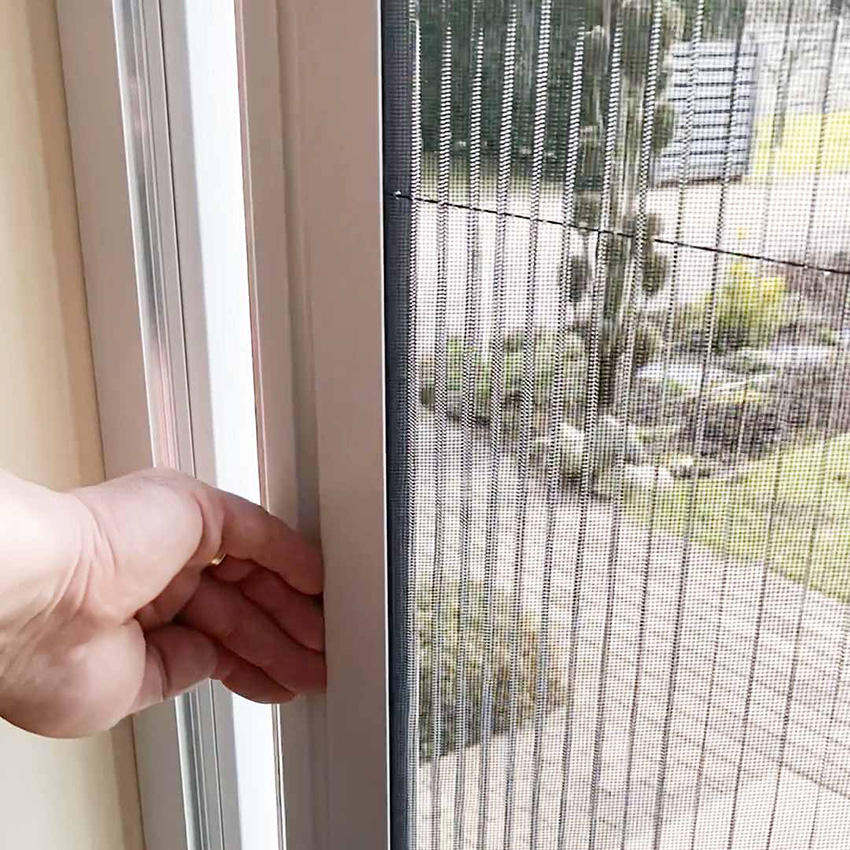
Winter Is Harder on Screens Than Summer Most screen door guides focus on insects and heat. But in Canada, Scandinavia, northern Japan, and the northern United States, a screen door faces a different set of stresses: freeze-thaw cycles, snow load, ice, and road salt. A screen that performs well in summer can fail within a single winter if the materials and installation are not chosen for cold.
The most common winter failure is not the mesh — it is the frame and the mounting hardware. Aluminum frames contract in cold, and adhesive tape loses grip below freezing. A screen that was installed in October can come loose by January if the adhesive was not rated for low temperatures.
Material Choices for Cold Climates Frame material: Aluminum alloy is the standard for folding screen doors, and it performs well in cold as long as the frame is thick enough. Thin aluminum frames can distort under snow load or ice accumulation. The FD01 uses a reinforced aluminum frame that holds its shape in freezing conditions.
Mesh material: 304 stainless steel mesh is the benchmark for cold climates because it does not become brittle at low temperatures. Standard fiberglass mesh can crack when flexed in extreme cold. For homes in snow country, stainless steel is the safer choice.
Adhesive and mounting: This is where most winter failures happen. Standard 3M adhesive tape is rated for a temperature range that often excludes deep winter. If the screen is installed in autumn, the adhesive may hold through the first cold snap and fail in the second. For permanent installations in cold climates, screw-fixed mounting is more reliable than adhesive. For renters who cannot drill, install the adhesive-mounted screen in spring or early summer, when the frame and tape are warm and the bond can cure properly.
Freeze-Thaw and Condensation Freeze-thaw cycles are the hidden enemy of screen doors. Water collects in the bottom track or frame channel, freezes overnight, and expands. Over a winter, this can distort the frame or crack the mesh where it meets the frame.
The practical fix is drainage: make sure the bottom of the screen frame does not trap water. A folding screen door that gathers to one side should have a clear path for meltwater to drain away. If the door sits on a threshold, check that the threshold slopes outward, not inward.
Condensation is a separate issue. In heated homes with cold outside air, moisture forms on the inside of the screen. Stainless steel mesh handles this without rusting; lower-grade mesh may corrode over multiple winters.
Road Salt and Coastal Salt Air In cities where roads are salted in winter, salt spray can reach screen doors on the ground floor or facing the street. Salt is corrosive to lower-grade metals. 304 stainless steel mesh and powder-coated aluminum frames resist salt far better than bare aluminum or standard fiberglass.
For coastal homes — common in Norway, Atlantic Canada, and northern Japan — salt air is a year-round issue, not just winter. The same material choices that handle road salt also handle coastal salt air.
Snow Load and Clearance A folding screen door on a patio or balcony can accumulate snow at the bottom. If the door opens outward, snow can block the opening. If it folds inward, snow can pile up against the screen and distort the bottom track.
For homes in heavy snow regions, the practical approach is to choose a screen that gathers to one side rather than one that opens outward, and to clear snow from the threshold before opening the door. The FD01’s folding design gathers to one side, which reduces the snow-blocking problem compared to an outward-opening screen.
Installation Timing The best time to install a screen door in a cold climate is late spring or early summer, not autumn. This gives adhesive time to cure at a stable warm temperature, and gives the homeowner a full season to check for issues before winter.
If the screen must be installed in cold weather, use screw-fixed mounting rather than adhesive, and check the mounting points again after the first freeze.
What to Ask Before Ordering For cold-climate customers, ask three questions: Is the mesh rated for low temperatures? Is the frame thick enough to resist snow load? Is the mounting method suitable for freezing conditions? The FD01 with 304 stainless steel mesh and screw-fixed mounting is the combination that performs best in cold climates. For renters who must use adhesive, install in warm weather and check the bond before the first winter.
A screen door that survives one winter is not the same as one that survives ten. In cold climates, the difference is in the material and mounting choices made before the first snowfall.